What Your AC's SEER2 Rating Means, and Why Your Quote Looks Different
The rating on the box measures one piece of your system. The number that matters is the whole system, installed in your house.
October 20, 2026 · 4 min read
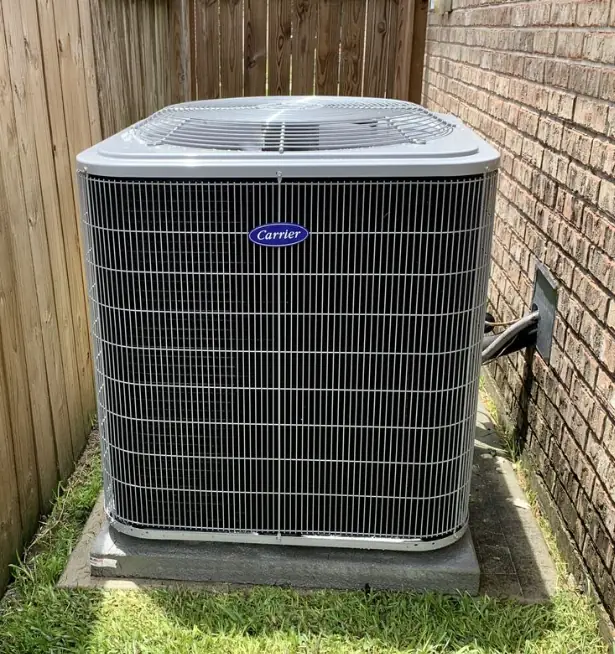
If you have shopped for a new air conditioner around Spring or The Woodlands, you have probably seen the yellow Energy Guide sticker with a SEER2 number on it, then received a quote that does not seem to line up with it. Nobody is pulling a fast one. The sticker and the quote describe two different things: a lab rating for one piece of equipment, and the real performance of a complete system installed in your actual house. Here is how to read both.
SEER2 in plain terms
SEER2 is the current efficiency rating for cooling equipment. It replaced the older SEER rating with a stricter test that better reflects the airflow resistance real ductwork puts on a system. Red Star's own FAQ notes that SEER2 can range anywhere from 14 to 43, and in general a higher number means the equipment delivers more cooling for each unit of electricity under the conditions of that test. The key phrase is under the conditions of that test. A rating is a measurement taken in a lab, and your attic, your ducts, and your August afternoons are not a lab.
Why the sticker and the quote do not match
Your air conditioner is not one machine. It is a matched combination: the outdoor condenser, the indoor coil, and the air handler or furnace blower all have to work together, and the ductwork carries the result through the house. Red Star explains in its FAQ that the system is rated as a matched combination, so the number on an Energy Guide label reflects one particular pairing of parts. Swap the indoor coil, pair the condenser with a different air handler, or connect everything to leaky ducts, and the efficiency you actually get changes with it. That is why a rating you read off a box at a home-improvement store rarely matches the figure a Carrier Factory Authorized Dealer quotes for your specific house.
Why a load analysis comes before the equipment
Efficiency is only half the question. The other half is size. Red Star's service lineup includes heating and cooling load calculations and AC system layout and design, and its FAQ points to an in-home load analysis as the way to work out which Carrier equipment fits a given home. A load calculation looks at the things that decide how much cooling a house needs: square footage, insulation, window area and orientation, how leaky the attic and walls are, and what the existing ductwork can actually deliver. Replacing a unit with the same tonnage as the old one skips all of that and assumes whoever installed the last one got it right.
In Houston-area homes, size matters even more than most people expect. A system that is too big cools the air quickly, shuts off, and never runs long enough to pull humidity out of the house, so the place feels clammy at a temperature that looks comfortable on the thermostat. It also starts and stops constantly, which is hard on the compressor. A system that is too small runs nonstop on a July afternoon and still loses ground. Neither problem shows up on an Energy Guide sticker.
Questions worth asking when you compare quotes
- Is the quote for a matched outdoor unit, indoor coil, and air handler or furnace, or only for the outdoor unit?
- Was a load calculation done for this house, or was the size simply copied from the old unit?
- Does the plan include any work on the ductwork, and if not, is the existing ductwork in good enough shape to carry a new system?
- What is the SEER2 rating of the complete matched system, not just the condenser?
What Red Star installs and backs
As a Carrier Factory Authorized Dealer, Red Star installs Split-System Air Conditioners, Packaged AC and Heating Systems, Terminal Air Conditioners, Ductless AC Systems, and Geothermal Heat Pumps, along with gas, oil, and electric furnaces on the heating side. The company's published terms for new work include the following.
- A 3-Year Labor Warranty, which Red Star describes as three times the industry standard
- A 10-Year Parts Warranty
- 100% free estimates
- 24/7 emergency service, 365 days a year, if something goes wrong later
What a replacement looks like from the customer side
One Google reviewer, Breanna Riggle, wrote about replacing her unit after a year of working with Red Star technician Jose. She said Jose "made sure we understood and had the best deal possible," and that the install crew of Christian, Adrian, and Marlin "took care in our home." Understanding the deal before the equipment goes in is the point of everything above, and it is the part no efficiency sticker can give you.
Honest recommendations over a quick sale
Red Star's promise to customers comes down to three things: honest recommendations, fast response times, and clear communication. Explaining why a SEER2 sticker cannot predict your bill is a small example of the first and third, and the load analysis behind it leaves you with equipment that fits the house rather than equipment that is merely installed in it.
Red Star Cooling and Heating has served Spring, The Woodlands, Conroe, Cypress, Houston, Tomball, Magnolia, Katy, Kingwood, Humble, and North Houston since 2006, completes more than 12,000 jobs a year, and holds a 4.9-star rating across 856 Google reviews. If your last quote left you squinting at a sticker, call (281) 651-7827 for a free estimate built around your house.
Red Star Cooling & Heating, (281) 651-7827
Call (281) 651-7827More articles
Choosing a Furnace or Heat Pump for a Spring, TX Home
A furnace that only runs a few months a year is easy to forget, until the one cold night it does not turn on.
Attic HVAC in a Spring Summer: What the Heat Does to Your Equipment
The hottest room in your house during July is probably the one with your HVAC equipment in it.