Attic HVAC in a Spring Summer: What the Heat Does to Your Equipment
The hottest room in your house during July is probably the one with your HVAC equipment in it.
October 20, 2026 · 4 min read
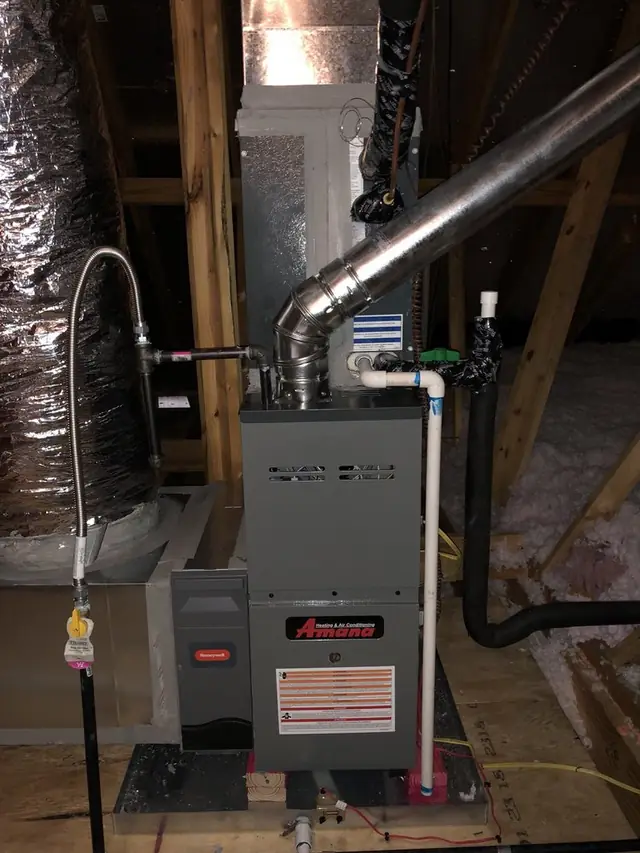
In many Spring and Woodlands homes, the furnace and air handler do not live in a hallway closet. They sit in the attic, under the roof, through a Texas summer. The layout makes sense on a floor plan, but it puts the equipment that works hardest all season inside the hottest space in the building. A few things follow from that, and most of them come down to catching small problems early.
What the heat adds
An attic in July can run far above the temperature of the rest of the house, often well over 100 degrees. That heat adds stress to motors, capacitors, wiring, and controls that are already working hard. Red Star's FAQ explains why preventative maintenance matters: a proper inspection can uncover leaks, rust, rot, soot, frayed wires, and corroded electrical contacts that the naked eye may not notice. Those are the kinds of problems that develop faster in a hot, enclosed space, and they are hard to spot from the attic hatch.
Drains deserve extra attention up there
An air conditioner pulls water out of the air, and that water has to go somewhere. When the equipment sits in the attic, the drain line and pan are directly above your ceiling. If the primary drain clogs, the secondary drain is the backup. Red Star's 30-point tune-up names both the primary and secondary drains as inspection points, and in an attic installation that item earns its place. A backed-up drain upstairs can become a stained ceiling downstairs.
The ductwork shares the space
The ducts often run through the attic too, with a plenum feeding insulated flex duct that joins at boots. Those connections can loosen or separate over time. Duct cleaning, sealing, and repair is part of Red Star's regular service lineup. A leak in attic ductwork sends conditioned air into the hottest part of the house, which means the system runs longer to make up the difference in the rooms you are actually using.
Running all day and night
Red Star names three common causes of emergency calls: outdated AC units, running the AC all day and night, and improper maintenance, which it calls its number one reason for emergency calls. During a Houston-area summer, an air conditioner can run for most of the day for weeks at a stretch. When the equipment is in an attic, that long run happens in the worst possible surroundings, which is how a small issue in June turns into a breakdown in July.
The 50% rule of thumb
Red Star also gives homeowners a simple guideline for aging equipment: when the cost of repairs is getting close to 50% of your system's original value, you are better off financially upgrading. If a replacement is on the table, it is also the right moment to ask about the ductwork and how the new system will be laid out, since Red Star's lineup includes AC system layout and design along with heating and cooling load calculations.
A summer breakdown, in a customer's words
One Google reviewer, Zach Woodum, wrote about his air conditioning going out in the middle of the night on a Friday. His regular service company could not start looking for a part until Monday, so he called 15 different 24-hour air conditioning companies. He wrote that "Red Star was the only company that came through." Technician Lee was at his front door about six hours later, and the system was fixed two hours after that. Whether the equipment sits in an attic or a garage, the question at that hour is simple: who will actually show up?
What to do about it
- Schedule maintenance before the heat arrives. Red Star's FAQ says heat pumps and AC equipment need it once a year, and gas-fired equipment about every other year.
- Do not climb into an attic in summer to troubleshoot. The heat is hard on the body, the footing is limited, and Red Star's own advice is to grab your phone, not a tool.
- Watch for water stains on ceilings near the attic access or under the equipment, which can point to a drain problem.
- Ask about the condition of the ductwork at any estimate, not just the equipment.
- Know in advance who you will call after hours.
Who does the climbing
Red Star Cooling and Heating describes itself as licensed and insured, locally owned and operated, and it has been serving the Spring and Woodlands area since 2006. For attic equipment, that kind of local experience counts, since part of the job before any repair starts is safely reaching the equipment and the ducts around it. The company is a Carrier Factory Authorized Dealer, backs its work with a 3-Year Labor Warranty and 10-Year Parts Warranty, and offers 24/7 emergency service, 365 days a year, if something fails mid-summer.
Red Star holds a 4.9-star rating from 856 Google reviews and serves Spring, The Woodlands, Conroe, Cypress, and greater Houston. If it has been more than a year since anyone actually looked at what is running above your ceiling, call (281) 651-7827 and get it on the schedule before the next heat wave.
Red Star Cooling & Heating, (281) 651-7827
Call (281) 651-7827More articles
What Your AC's SEER2 Rating Means, and Why Your Quote Looks Different
The rating on the box measures one piece of your system. The number that matters is the whole system, installed in your house.
Choosing a Furnace or Heat Pump for a Spring, TX Home
A furnace that only runs a few months a year is easy to forget, until the one cold night it does not turn on.