Red Star Advantage / Extended Warranties
The Red Star Advantage membership
Two pre-paid tune-ups a year, one for cooling and one for heating, with front of the line scheduling and savings on parts and labor.
Chapter 01
Two visits a year, booked before you think of them
The Red Star Advantage plan, also called the Star Membership, is built around two pre-paid annual tune-ups. In spring and summer, a technician runs a 30-point inspection on the air conditioning. In fall and winter, a matching 30-point inspection covers the heating system. Between them, both halves of the year are looked at before the weather forces the question.
The part most maintenance plans leave to the homeowner is the calendar. With Red Star, scheduling is automatic: we track your tune-ups and contact you to book them. Nothing depends on remembering that the last visit was in April, and the visit that would otherwise be put off until the system complains simply happens.
Members around Spring, The Woodlands and Greater Houston get the same Carrier Factory Authorized dealer that handles repairs and installs, so the technician checking a system during a tune-up works for the company that stands behind the equipment afterwards.
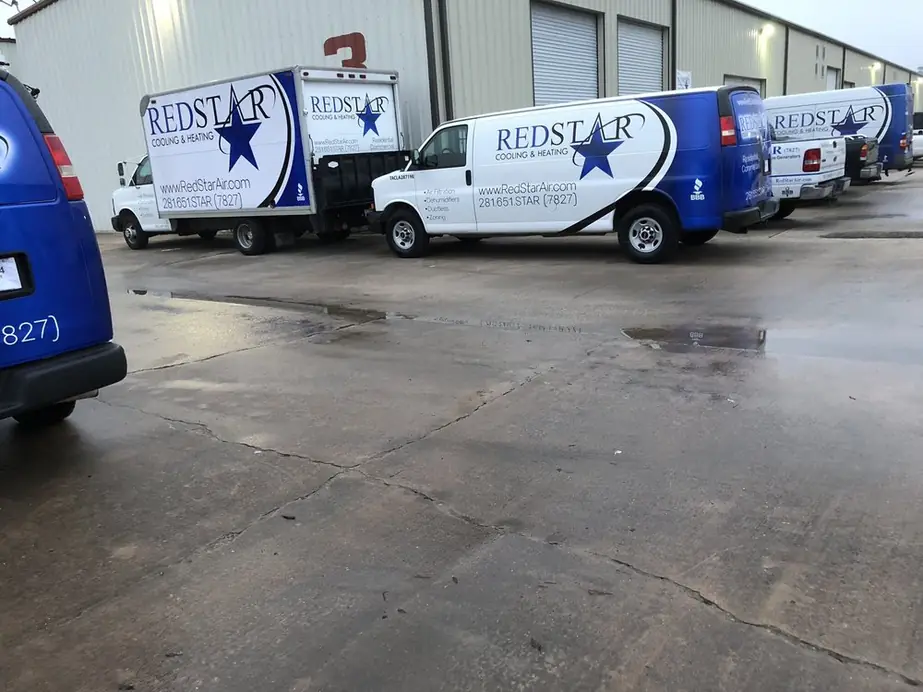
The Red Star fleet: a box truck and branded vans parked outside the company warehouse
Why a scheduled visit beats an emergency call
Preventative maintenance uncovers leaks, rust, rot, soot, frayed wires and corroded electrical contacts that the naked eye may not notice. Red Star is direct about the other side of that: improper maintenance is the company's number one reason for emergency calls. Finding a worn part at a scheduled visit is a far calmer event than finding it on a holiday weekend in August.
Different equipment needs different timing. Heat pumps and air conditioners want a professional tune-up once a year. Gas-fired equipment only needs servicing every other year. A plan with two visits a year covers both the cooling season and the heating season, and gives the technician a chance to look at the whole system rather than half of it. A technician who sees the same system twice a year also learns how it behaves, which is worth more at the next emergency than any one checklist line.
The cooling inspection is a published list, not a vague promise. Nine named checks sit inside it, set out in the section below, and each one is something a customer can ask a technician about while the panel is open. Operating pressures for the proper refrigerant charge, voltage and amp draw on every motor and loose electrical connections are the kind of items that cannot be judged by listening to the unit run.
Chapter 03
What changes the night something actually breaks
Members get front of the line VIP scheduling for both standard and emergency service. The company runs emergency repairs 24 hours a day, 365 days a year, and membership puts you ahead of the queue when several people are calling at once, which is exactly what happens on the first brutal afternoon of summer.
Membership also carries up to 10% off parts and labor, and extended warranties on parts and labor. Red Star publishes a three-year labor warranty and a ten-year parts warranty on its work, so the extended coverage builds on top of an already long baseline.
The price is $200 a year paid in full, or $15 a month for the first system and $10 a month for each additional system. To enroll, or to ask which of your systems the plan covers, call (281) 651-7827 and a person will walk you through it.
Two pre-paid 30-point tune-ups, up to 10% off parts and labor, front of the line scheduling and extended warranties, from a Carrier Factory Authorized dealer. Call (281) 651-7827.
The nine named checks on the cooling side
This is the published list from the spring and summer inspection, grouped the way a technician works through a system. A matching 30-point run covers heating in the fall.
Coils and drains
Where a summer breakdown tends to start.
- Inside cooling coil
- Primary and secondary drains
- Outdoor condenser coil cleanliness
Charge and airflow
What decides whether cold air reaches the room.
- Operating pressures for proper refrigerant charge
- Blower component adjustment
- AC cycle monitoring
Electrics and controls
The failures that arrive with no warning.
- Voltage and amp draw on all motors
- Loose electrical connections
- Thermostat operation
Wondering what happens in a heating visit? The heating page covers the equipment the fall inspection looks at.